Note
Go to the end to download the full example code.
Experiment simulation in 2D
In previous examples we have built our virtual sensor array and used this to run a single simulated experiment. However, we will generally want to run many simulated experiments and perform statistical analysis on the results. In this example we demonstrate how pyvale can be used to run a set of simulated experiments with a series of sensor arrays, one measuring temperature and the other measuring displacement. We also show how this analysis can be performed over a set of input physics simulations with different parameters.
Note that this example has minimal explanation and assumes you have reviewed the basic sensor simulation examples to understand how the underlying engine works as well as the sensor simulation workflow.
1. Load physics simulation data
sim_paths: list[Path] = dataset.thermomechanical_2d_experiment_paths()
sim_keys: set[str] = {"sim_nominal","sim_perturbed"}

disp_keys = ("disp_x","disp_y")

sim_data_dict: dict[str,io.SimData] = {}
for ss,kk in zip(sim_paths,sim_keys):
    sim_data = mh.ExodusLoader(ss).load_all_sim_data()
    sim_data = sens.scale_length_units(scale=1000.0,
                                       sim_data=sim_data,
                                       disp_keys=disp_keys)
    sim_data_dict[kk] = sim_data
2. Build virtual sensor arrays
sim_dims: dict[str,tuple[float,float]] = sens.simtools.get_sim_dims(sim_data)

sample_times = np.linspace(0.0,np.max(sim_data.time),50)
2.1 Build scalar field sensor array
temp_sens_pos: np.ndarray = sens.gen_pos_grid_inside(num_sensors=(4,1,1),
                                                     x_lims=sim_dims["x"],
                                                     y_lims=sim_dims["y"],
                                                     z_lims=(0.0,0.0))

temp_sens_data = sens.SensorData(positions=temp_sens_pos,
                                 sample_times=sample_times)

temp_sens: sens.SensorsPoint = sens.SensorFactory.scalar_point(
    sim_data,
    temp_sens_data,
    comp_key="temperature",
    spatial_dims=sens.EDim.TWOD,
    descriptor=sens.DescriptorFactory.temperature(),
)
2.2 Add errors to the scalar field sensors
temp_pos_uncert = 1.0 # units = mm
temp_pos_rand = (sens.GenUniform(low=-temp_pos_uncert,high=temp_pos_uncert),
                 sens.GenUniform(low=-temp_pos_uncert,high=temp_pos_uncert),
                 None)

temp_field_err_data = sens.ErrFieldData(pos_rand_xyz=temp_pos_rand)

temp_err_chain: list[sens.IErrSimulator] = [
    sens.ErrSysField(temp_sens.get_field(),temp_field_err_data),
    sens.ErrRandGenPercent(sens.GenNormal(std=1.0),
                           err_dep=sens.EErrDep.DEPENDENT),
    sens.ErrSysOffsetPercent(offset_percent=-1.0),
    sens.ErrSysDigitisation(bits_per_unit=2**24/100),
    sens.ErrSysSaturation(meas_min=0.0,meas_max=700.0),
]

temp_sens.set_error_chain(temp_err_chain)
2.3 Build vector field sensor array
disp_sens_pos: np.ndarray = sens.gen_pos_grid_inside(num_sensors=(2,2,1),
                                                     x_lims=sim_dims["x"],
                                                     y_lims=sim_dims["y"],
                                                     z_lims=(0.0,0.0))

sens_angles: tuple[Rotation] = (
    Rotation.from_euler("zyx",[0,0,0], degrees=True),
)

disp_sens_data = sens.SensorData(positions=disp_sens_pos,
                                 sample_times=sample_times)

disp_sens: sens.SensorsPoint = sens.SensorFactory.vector_point(
    sim_data,
    disp_sens_data,
    comp_keys=disp_keys,
    spatial_dims=sens.EDim.TWOD,
    descriptor=sens.DescriptorFactory.displacement(),
)
2.4 Add errors to the vector field sensors
pos_rand = sens.GenUniform(low=-1.0,high=1.0)   # units = mm
angle_rand = sens.GenUniform(low=-2.0,high=2.0) # units = degrees

field_err_data = sens.ErrFieldData(pos_rand_xyz=(pos_rand,pos_rand,None),
                                   ang_rand_zyx=(angle_rand,None,None))

disp_err_chain: list[sens.IErrSimulator] = [
    sens.ErrRandGenPercent(sens.GenNormal(std=1.0)),
    sens.ErrSysField(disp_sens.get_field(),field_err_data),
    sens.ErrSysOffsetPercent(offset_percent=1.0),
    sens.ErrSysDigitisation(bits_per_unit=2**24/1.0),
    sens.ErrSysSaturation(meas_min=-5.0,meas_max=5.0),
]

disp_sens.set_error_chain(disp_err_chain)
3. Create & run simulated experiments
sensor_arrays: dict[str,sens.ISensorArray] = {
    "temp": temp_sens,
    "disp": disp_sens,
}

exp_sim_opts = sens.ExpSimOpts(workers=4,para=sens.EExpSimPara.ALL)
exp_save_keys = sens.ExpSimSaveKeys(pert_sens_times=None)

exp_sim = sens.ExperimentSimulator(sim_data_dict,
                                   sensor_arrays,
                                   exp_sim_opts,
                                   exp_save_keys)

start_exp: float = time.perf_counter()
exp_data: dict[tuple[str,...],np.ndarray] = (
    exp_sim.run_experiments(num_exp_per_sim=1000)
)
exp_time: float = time.perf_counter() - start_exp

start_stats: float = time.perf_counter()
exp_stats: dict[tuple[str,...],sens.ExpSimStats] = (
    sens.calc_exp_sim_stats(exp_data)
)
stats_time: float = time.perf_counter() - start_stats

print(80*"-")
print(f"Exp. sim. time    = {exp_time:.3f} seconds")
print(f"Stats. calc. time = {stats_time:.3f} seconds")
print(80*"-")
print()

4. Analyse & visualise the results
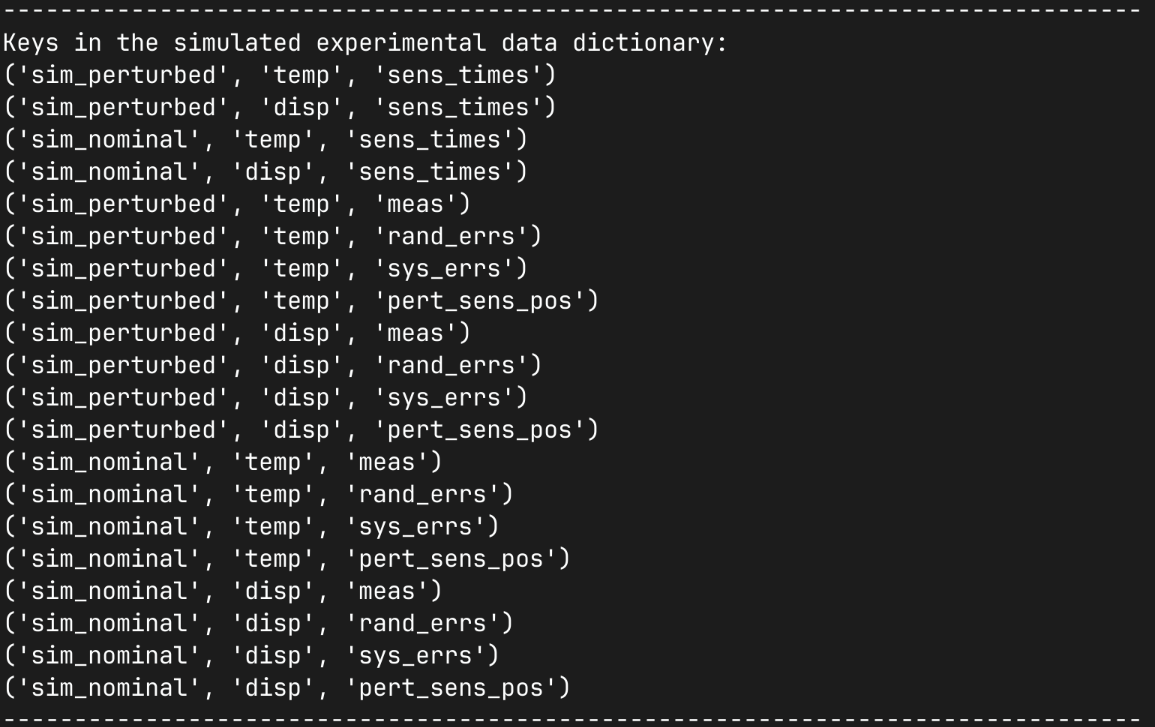
print(80*"-")
print("Thermal sensor array:")
print()
print(f"    {exp_data[('sim_nominal','temp','meas')].shape=}")
print("    shape=(n_exps,n_sensors,n_field_comps,n_time_steps)")
print()
print(f"    {exp_stats[('sim_nominal','temp','meas')].max.shape=}")
print("    shape=(n_sensors,n_field_comps,n_time_steps)")
print()
print(f"    {exp_data[('sim_nominal','temp','pert_sens_pos')].shape=}")
print("    shape=(n_exps,n_sensors,coord[X,Y,Z])")
print()
print(80*"-")
print("Mechanical sensor array:")
print()
print(f"    {exp_data[('sim_nominal','disp','meas')].shape=}")
print("    shape=(n_exps,n_sensors,n_field_comps,n_time_steps)")
print()
print(f"    {exp_stats[('sim_nominal','disp','meas')].max.shape=}")
print("    shape=(n_sensors,n_field_comps,n_time_steps)")
print()
print(f"    {exp_data[('sim_nominal','disp','pert_sens_pos')].shape=}")
print("    shape=(n_exps,n_sensors,coord[X,Y,Z])")
print()
print(80*"-")

output_path: Path = Path.cwd() / "pyvale-output"
if not output_path.is_dir():
    output_path.mkdir(parents=True, exist_ok=True)


sens.save_exp_sim_data(output_path/"ex5a_exp_sim_data.npz",exp_data)
exp_data = sens.load_exp_sim_data(output_path/"ex5a_exp_sim_data.npz")


pert_sens_pos = exp_data[("sim_nominal","temp","pert_sens_pos")][-1,:,:]
pv_plot = sens.plot_point_sensors_on_sim(sensor_array=temp_sens,
                                         comp_key="temperature",
                                         time_step=-1,
                                         perturbed_sens_pos=pert_sens_pos)
pv_plot.camera_position = "xy"

# Set to False to show an interactive plot instead of saving the figure
pv_plot.off_screen = True
if pv_plot.off_screen:
    pv_plot.screenshot(output_path/"ext_ex5a_temp_locs.png")
else:
    pv_plot.show()
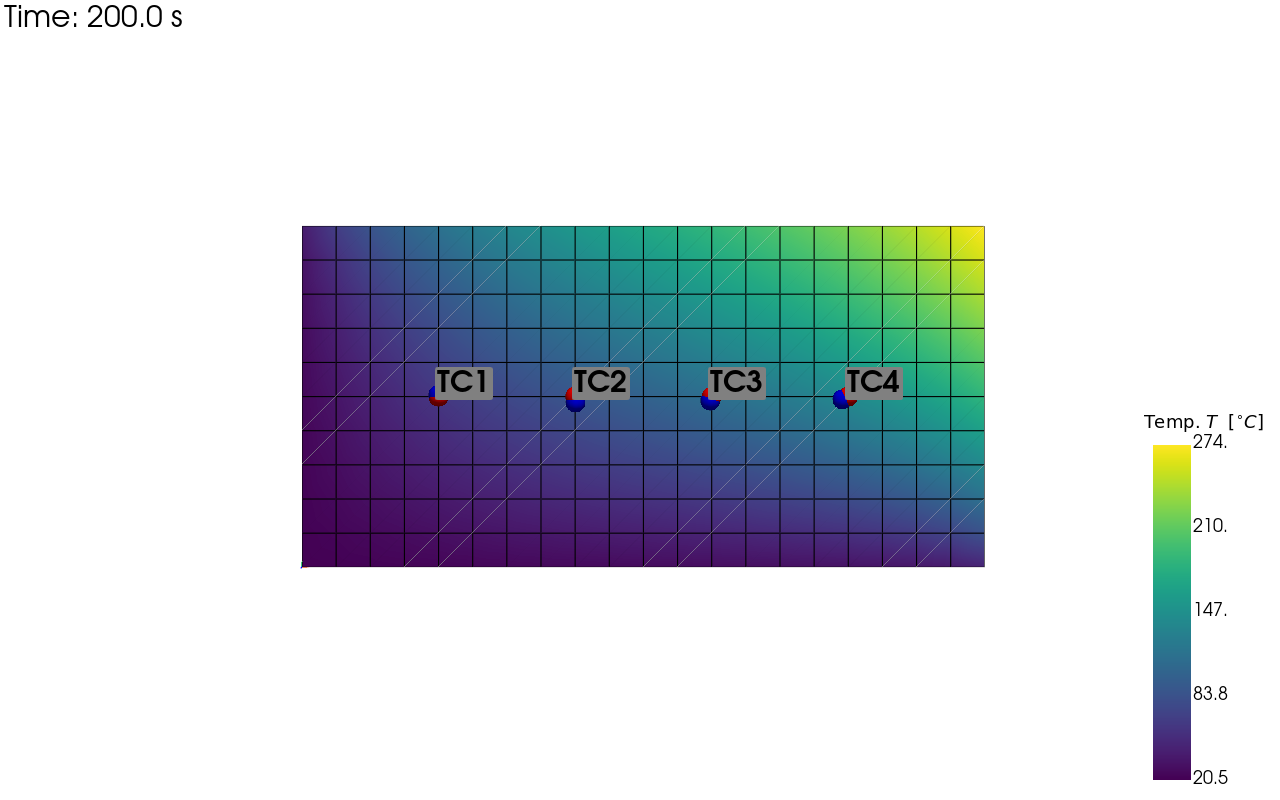
Visualisation of the virtual temperature sensor locations:
pert_sens_pos = exp_data[("sim_nominal","disp","pert_sens_pos")][-1,:,:]
pv_plot = sens.plot_point_sensors_on_sim(sensor_array=disp_sens,
                                         comp_key="disp_x",
                                         time_step=-1,
                                         perturbed_sens_pos=pert_sens_pos)
pv_plot.camera_position = "xy"

# Set to False to show an interactive plot instead of saving the figure
pv_plot.off_screen = True
if pv_plot.off_screen:
    pv_plot.screenshot(output_path/"ext_ex5a_disp_locs.png")
else:
    pv_plot.show()

# Uncomment to show interactive figure and set off_screen = False above
# pv_plot.show()
Visualisation of the virtual displacement sensor locations:

for kk in sim_data_dict:
    (fig,ax) = sens.plot_exp_traces(
        exp_data,
        comp_ind=0,
        sens_key="temp",
        sim_key=kk,
        descriptor=sens.DescriptorFactory.temperature(),
    )

    save_fig: Path = output_path/f"ext_ex5a_traces_{kk}_temp.png"
    fig.savefig(save_fig,dpi=300,bbox_inches="tight")
Simulated temperatures traces for input physics simulation 0:
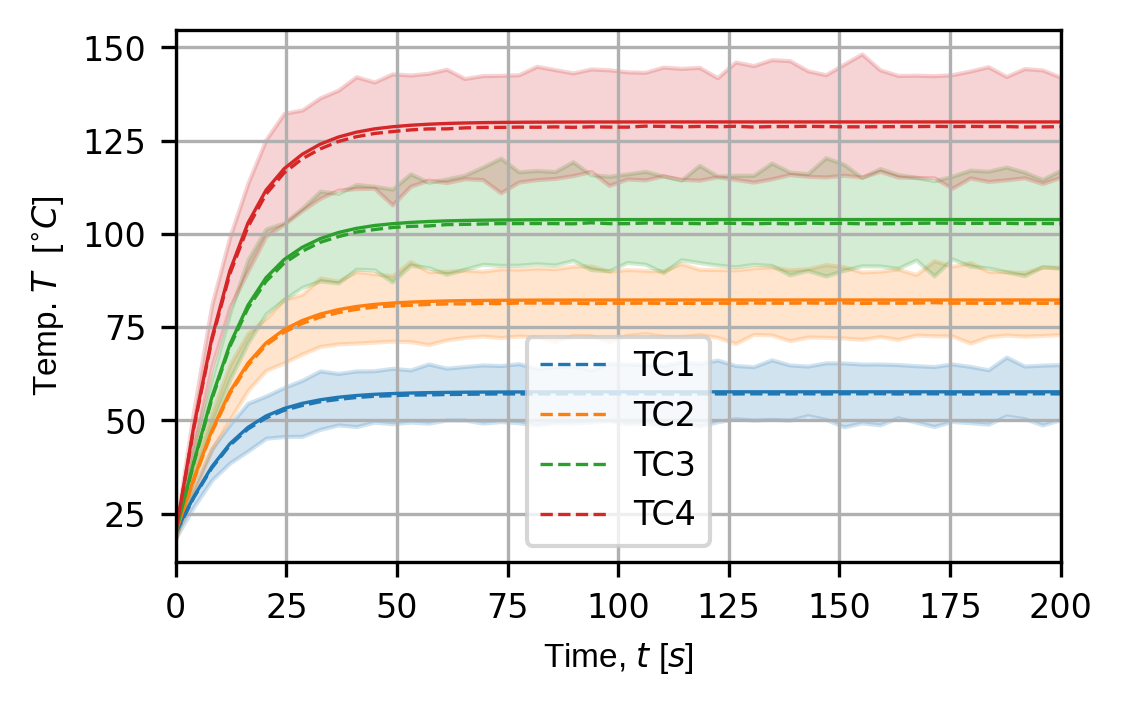
Simulated temperature traces for input physics simulation 1:

for key_sim in sim_data_dict:
    for ii,key_disp in enumerate(disp_keys):
        (fig,ax) = sens.plot_exp_traces(
            exp_data,
            comp_ind=ii,
            sens_key="disp",
            sim_key=key_sim,
            descriptor=sens.DescriptorFactory.displacement(),
        )

        save_fig: Path = (output_path
            /f"ext_ex5a_traces_{key_sim}_{key_disp}.png")
        fig.savefig(save_fig,dpi=300,bbox_inches="tight")
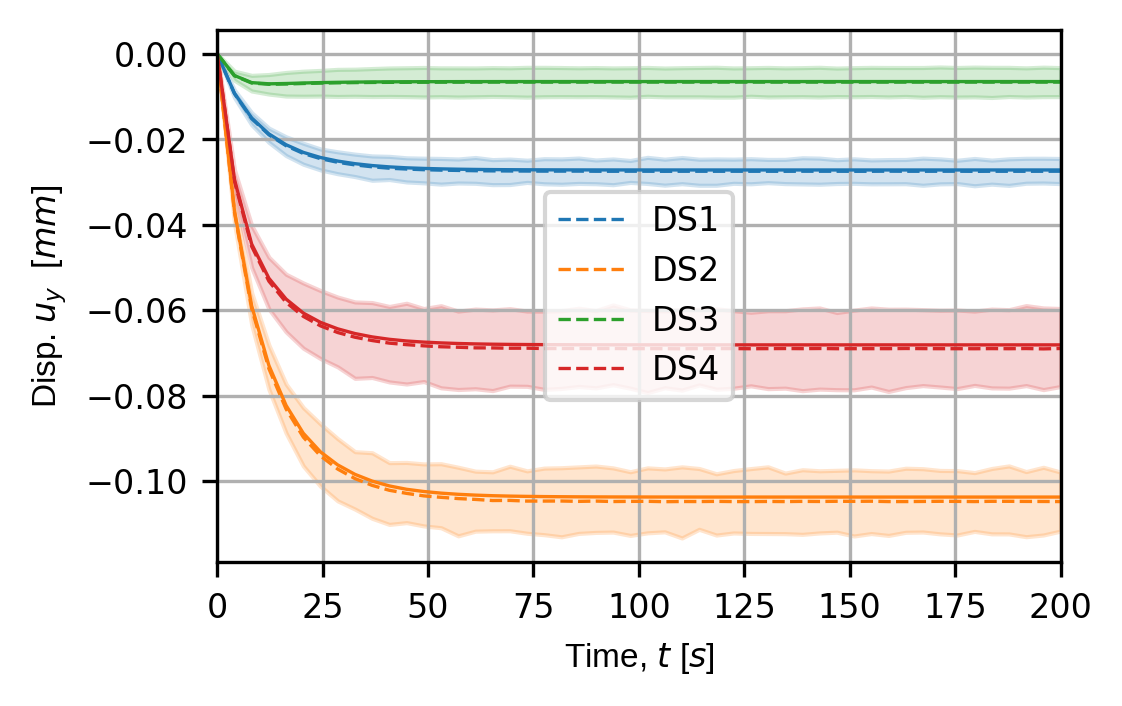
Simulated displacement traces for input physics simulation 0:
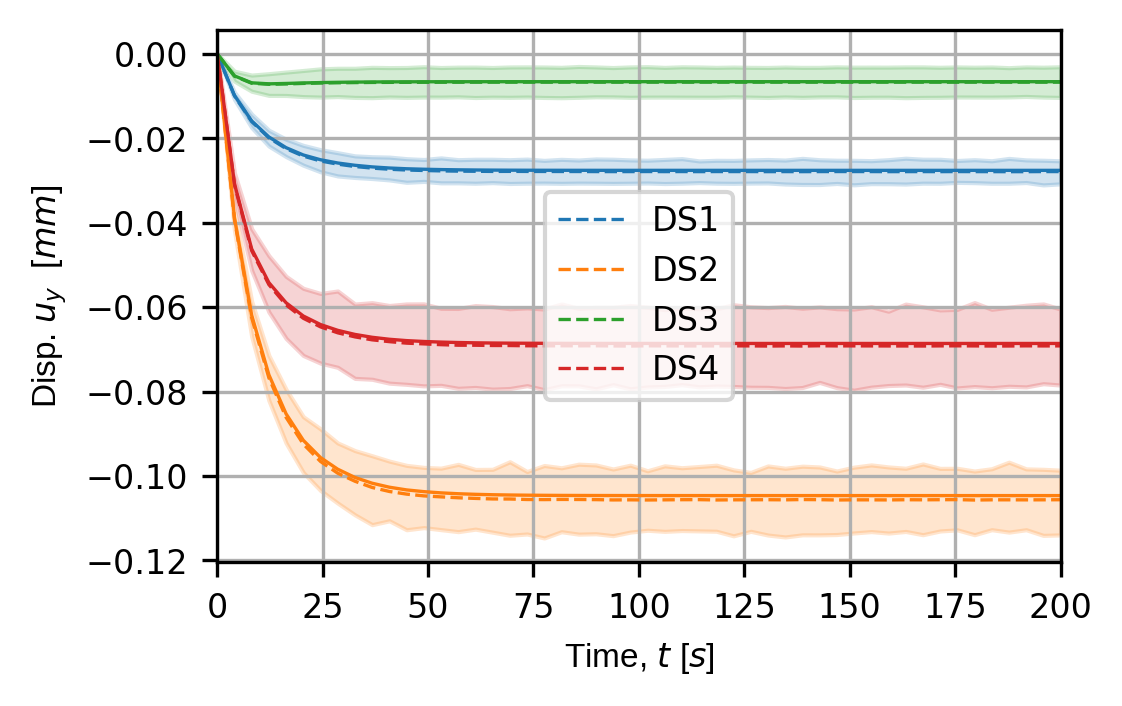
Simulated displacement traces for input physics simulation 1:
# Uncomment this to display the sensor trace plot
# plt.show()