Note
Go to the end to download the full example code.
Render UVs: Compare texture boundary modes
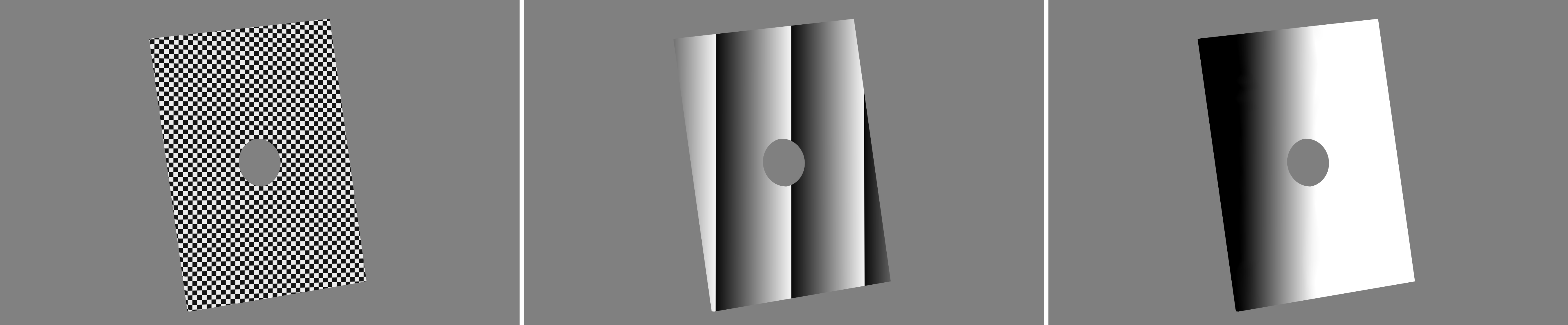
Here we map a three dimensional plate with hole mesh beyond a source texture’s pixel bounds. We compare a seamless periodic texture, a non periodic texture whose repeated edges form a seam, and the default saturated boundary mode.
1. Load and orient the packaged plate with hole mesh
The native PyVale CSV loader provides the three dimensional surface mesh. Rotating about its centre makes the hole and exposed side edges legible.
data_dir = dataset.riley_platehole_csv_case_path()
simulation = io.MeshLoader(
    load_dir=data_dir,
    coords_file="coords.csv",
    connect_files="connect.csv",
    load_opts=io.SimLoadOpts(coord_header=None),
).load_mesh()

base_mesh = render.meshes3d_from_simdata(
    simulation,
    {"connect": riley.ConnectConvention(
        riley.EElemType.QUAD8, riley.EConnectAxis.ROW, 0,
        riley.ENodeOrder.RILEY,
    )},
)["connect"]

oriented_mesh = render.mesh_rotate(
    base_mesh,
    Rotation.from_euler("xyz", (0.0, 22.0, 8.0), degrees=True),
    pivot=render.mesh_center(base_mesh),
)
2. Build the experimental camera and calculate its image scale
camera = render.Camera(
    pixels_num=np.array((1792, 1120)),
    pixels_size=np.array((5.5e-6, 5.5e-6)),
    pos_world=np.zeros(3),
    rot_world=Rotation.identity(),
    roi_cent_world=render.mesh_center(oriented_mesh),
    focal_length=35.0e-3,
    subsample=4,
)

camera = render.cam_frame_mesh(
    camera,
    oriented_mesh,
    fov_scale=render.cam_coverage_to_fov_scale(0.90),
)

image_leng_per_px = render.cam_calc_leng_per_px(camera)
3. Build periodic and non periodic source textures
A periodic checker repeats without a seam. A horizontal ramp is deliberately non periodic: its bright right edge meets its dark left edge when tiled, so the boundary is unmistakable in the rendered result.
tile_size = 128
tile_columns, tile_rows = np.meshgrid(
    np.arange(tile_size),
    np.arange(tile_size),
)
checker = ((tile_columns // 16 + tile_rows // 16) % 2) * 190 + 32
seamless_texture = checker.astype(np.uint8)
ramp = np.linspace(24, 232, 256, dtype=np.uint8)
nonperiodic_texture = np.tile(ramp, (tile_size, 1))
4. Define a physical feature size and cross the texture boundary
The checker has 16 texture pixels per square. Requesting 16 image pixels per square and using the camera scale defines its physical size. Moving the mapping centre close to the right edge guarantees that the plate crosses a boundary in both the tiled and saturated cases.
texture_px_per_leng = render.uv_calc_texture_px_per_leng_from_image(
    texture_px_per_feature=16.0,
    image_px_per_feature=16.0,
    image_leng_per_px=image_leng_per_px,
)
nonperiodic_height, nonperiodic_width = nonperiodic_texture.shape[:2]

seamless_mapping = render.uv_map_planar_scaled(
    oriented_mesh.coords,
    seamless_texture,
    texture_px_per_leng,
    plane=render.EUVPlane.XY,
    texture_center_px=np.array((0.90 * tile_size, 0.50 * tile_size)),
    bounds=render.EUVBounds.TILED,
)

seamed_mapping = render.uv_map_planar_scaled(
    oriented_mesh.coords,
    nonperiodic_texture,
    texture_px_per_leng,
    plane=render.EUVPlane.XY,
    texture_center_px=np.array(
        (0.90 * nonperiodic_width, 0.50 * nonperiodic_height)
    ),
    bounds=render.EUVBounds.TILED,
)

saturated_mapping = render.uv_map_planar_scaled(
    oriented_mesh.coords,
    nonperiodic_texture,
    texture_px_per_leng,
    plane=render.EUVPlane.XY,
    texture_center_px=np.array(
        (0.90 * nonperiodic_width, 0.50 * nonperiodic_height)
    ),
)
5. Render the three texture boundary cases
output_dir = Path.cwd() / "pyvale-output" / "renderuvs_ex1c_uv_pixel_region"

for variant_name, mapping in (
    ("seamless", seamless_mapping),
    ("tiled_seam", seamed_mapping),
    ("saturated", saturated_mapping),
):
    textured_mesh = render.Mesh3D(
        element_type=oriented_mesh.element_type,
        coords=oriented_mesh.coords,
        connectivity=oriented_mesh.connectivity,
        shader=riley.TextureShader(
            uvs=mapping.uvs,
            texture=mapping.texture[None, :, :],
        ),
    )
    render_uv_example(textured_mesh, camera, output_dir / variant_name)

print(f"Rendered the texture boundary comparisons to {output_dir}")
print(
    f"Image scale={image_leng_per_px:.6g} length/px, "
    f"seamless tiles={seamless_mapping.tile_counts}, "
    f"non periodic tiles={seamed_mapping.tile_counts}"
)
From left to right: a periodic texture tiles seamlessly, a non periodic source exposes its repeated edge, and saturation stretches the edge pixels wherever the requested mapping lies beyond the source image.