Note
Go to the end to download the full example code.
Render UVs: Projection onto an arbitrary plane
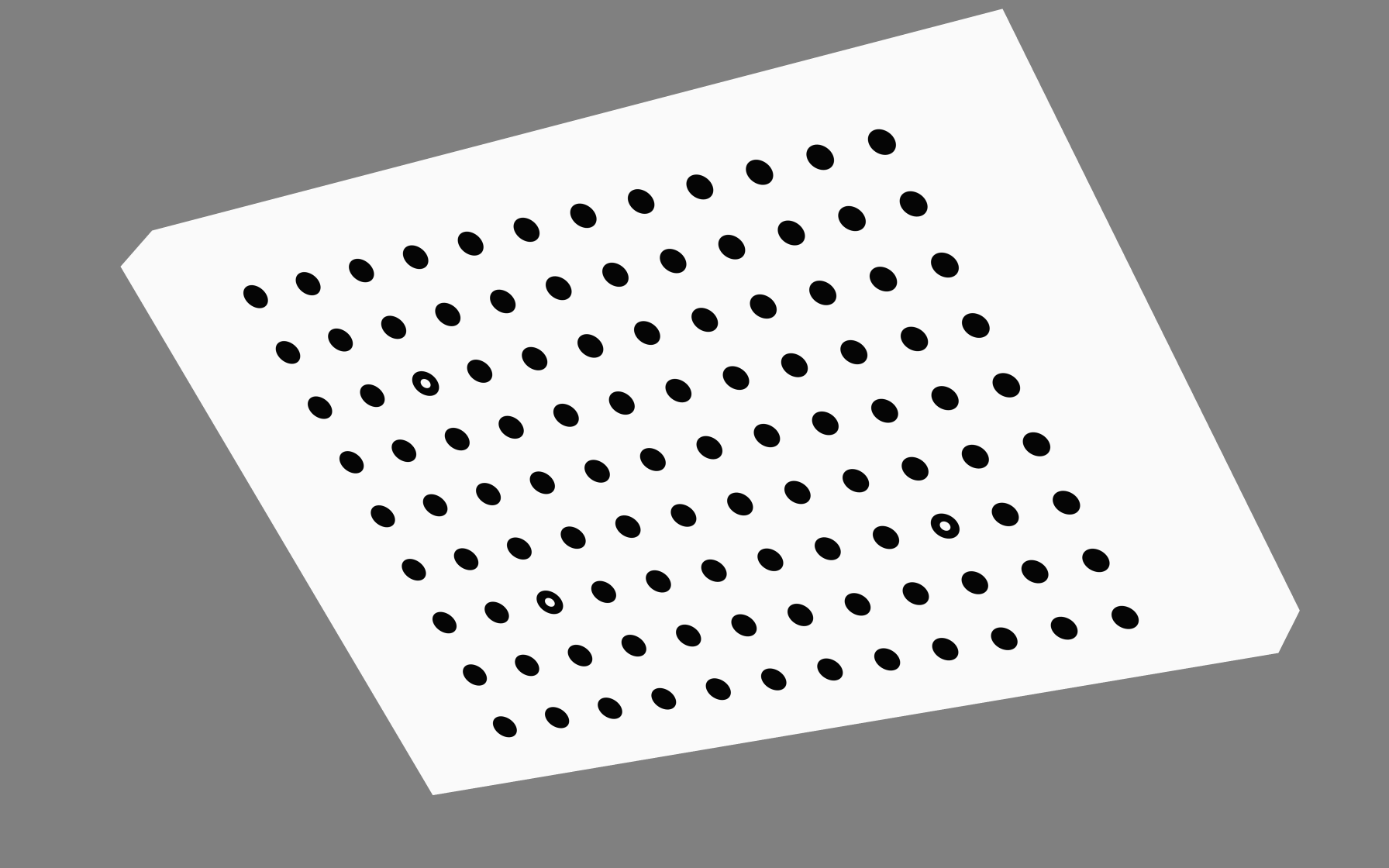
This example rotates the packaged three dimensional calibration plate and generates UVs from its rotated local surface plane. The plate thickness and an oblique camera view make the arbitrary physical orientation clear.
1. Load and tilt the three dimensional calibration plate
data_dir = dataset.riley_stereocal_case_path()
simulation = io.MeshLoader(
    load_dir=data_dir,
    coords_file="coords.csv",
    connect_files="connect.csv",
    load_opts=io.SimLoadOpts(coord_header=None),
).load_mesh()

base_mesh = render.meshes3d_from_simdata(
    simulation,
    {"connect": riley.ConnectConvention(
        riley.EElemType.TRI3, riley.EConnectAxis.ROW, 0,
        riley.ENodeOrder.RILEY,
    )},
)["connect"]
plate_rotation = Rotation.from_euler("xyz", (28.0, -34.0, 12.0), degrees=True)

oriented_mesh = render.mesh_rotate(
    base_mesh,
    plate_rotation,
    pivot=render.mesh_center(base_mesh),
)
2. Define the rotated surface plane and generate UV coordinates
The original plate face lies in XY. Rotating its normal and local V axis provides the arbitrary plane definition without manually deriving a basis.
plane = render.UVPlane(
    normal=plate_rotation.apply(np.array((0.0, 0.0, 1.0))),
    origin=render.mesh_center(oriented_mesh),
    up=plate_rotation.apply(np.array((0.0, 1.0, 0.0))),
)

texture = riley.load_texture_mono_u8(dataset.riley_cal_target_texture_path())

texture_px_per_leng = render.uv_calc_texture_px_per_leng(
    texture_px_per_feature=177.1,
    feature_leng=1.25e-3,
)

mapping = render.uv_map_planar_scaled(
    oriented_mesh.coords,
    texture[0],
    texture_px_per_leng,
    plane=plane,
)

textured_mesh = render.Mesh3D(
    element_type=oriented_mesh.element_type,
    coords=oriented_mesh.coords,
    connectivity=oriented_mesh.connectivity,
    shader=riley.TextureShader(
        uvs=mapping.uvs,
        texture=mapping.texture[None, :, :],
    ),
)
3. Render the arbitrary plane mapping
output_dir = Path.cwd() / "pyvale-output" / "renderuvs_ex1d_uv_arbitrary_plane"

camera = render.Camera(
    pixels_num=np.array((1792, 1120)),
    pixels_size=np.array((5.5e-6, 5.5e-6)),
    pos_world=np.zeros(3),
    rot_world=Rotation.identity(),
    roi_cent_world=render.mesh_center(oriented_mesh),
    focal_length=35.0e-3,
    subsample=4,
)

camera = render.cam_frame_mesh(
    camera,
    oriented_mesh,
    fov_scale=render.cam_coverage_to_fov_scale(0.90),
)

render_uv_example(textured_mesh, camera, output_dir / "tilted")

image_leng_per_px = render.cam_calc_leng_per_px(camera)
image_px_per_feature_pitch = render.uv_calc_image_px_per_feature(
    1.25e-3,
    image_leng_per_px,
)

print(f"Rendered the arbitrary plane UV mapping to {output_dir}")
print(
    f"The 1.25 mm feature pitch is approximately "
    f"{image_px_per_feature_pitch:.2f} px at the ROI"
)
The tilted calibration plate is mapped using its rotated local surface plane.