Note
Go to the end to download the full example code.
Parallel IR camera validation
Compare serial and four-worker AVM calculations for an infrared camera viewing a heated plate.
from itertools import count
from pathlib import Path
from time import perf_counter

import matplotlib
import matplotlib.pyplot as plt
import numpy as np

import pyvale.validation as vl
matplotlib.use("Agg")

SHOW_PLOTS = False
if SHOW_PLOTS:
    plt.switch_backend("QtAgg")

output_path = Path.cwd() / "pyvale-output" / "valid_ex12_parallel_ir_camera"
output_path.mkdir(parents=True, exist_ok=True)
fig_nums = count(1)
1. Configure the camera and sampling study
Each pixel represents one validation point. The steady-state experiment uses repeated frames for aleatory noise and different assumed emissivities for epistemic uncertainty.
CAMERA_WIDTH = 640
CAMERA_HEIGHT = 480
FRAME_COUNT = 20
SIM_EMISSIVITY_COUNT = 12
EXP_EMISSIVITY_COUNT = 12
NOISE_STD_DEGC = 0.05
PLATE_WIDTH_M = 0.64
PLATE_HEIGHT_M = 0.48
2. Generate plate temperatures and camera samples
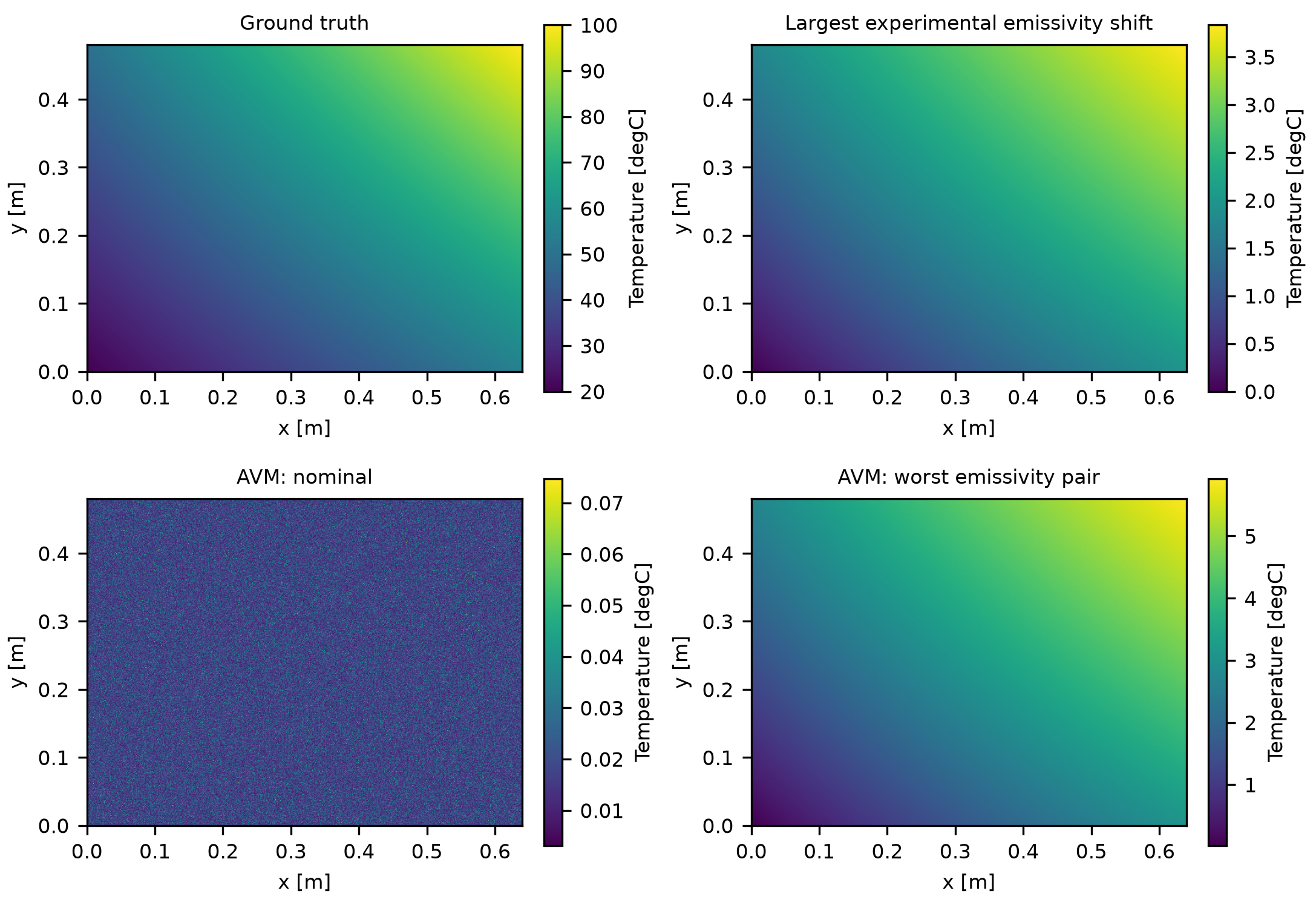
The bilinear temperature field ranges from 20 degC at the bottom left to 100 degC at the top right. The radiance inversion yields a temperature shift for each pixel and emissivity assumption. Broadcast those shifts across the noisy frames to produce arrays ordered by pixel, emissivity case, and frame.
setup_start = perf_counter()

normalized_x, normalized_y = np.meshgrid(
    np.linspace(0.0, 1.0, CAMERA_WIDTH),
    np.linspace(0.0, 1.0, CAMERA_HEIGHT),
)

ground_truth = (
    20.0
    + 35.0 * normalized_x
    + 30.0 * normalized_y
    + 15.0 * normalized_x * normalized_y
)

coords = np.column_stack(
    (
        PLATE_WIDTH_M * normalized_x.ravel(),
        PLATE_HEIGHT_M * normalized_y.ravel(),
        np.zeros(ground_truth.size),
    )
)

kelvin_offset = 273.15
reflected_kelvin = 20.0 + kelvin_offset
true_emissivity = 0.95

radiance_contrast = (
    true_emissivity * ((ground_truth + kelvin_offset) ** 4 - reflected_kelvin**4)
).reshape(-1, 1)

sim_assumed_emissivities = np.concatenate(
    ([true_emissivity], np.linspace(0.86, 0.94, SIM_EMISSIVITY_COUNT - 1))
)
exp_assumed_emissivities = np.concatenate(
    ([true_emissivity], np.linspace(0.89, 0.94, EXP_EMISSIVITY_COUNT - 1))
)

sim_epistemic_temperature_shift = (
    (reflected_kelvin**4 + radiance_contrast / sim_assumed_emissivities) ** 0.25
    - kelvin_offset
    - ground_truth.reshape(-1, 1)
).astype(np.float32)
exp_epistemic_temperature_shift = (
    (reflected_kelvin**4 + radiance_contrast / exp_assumed_emissivities) ** 0.25
    - kelvin_offset
    - ground_truth.reshape(-1, 1)
).astype(np.float32)

generator = np.random.default_rng(2871)
frame_sample_shape = (ground_truth.size, FRAME_COUNT)
ground_truth_by_pixel = ground_truth.astype(np.float32).reshape(-1, 1)

sim_aleatory_noise = NOISE_STD_DEGC * generator.standard_normal(
    frame_sample_shape, dtype=np.float32
)
exp_aleatory_noise = NOISE_STD_DEGC * generator.standard_normal(
    frame_sample_shape, dtype=np.float32
)

sim_nominal_temperature_samples = ground_truth_by_pixel + sim_aleatory_noise
exp_nominal_temperature_samples = ground_truth_by_pixel + exp_aleatory_noise

sim_temperature_samples = (
    sim_nominal_temperature_samples[:, None, :]
    + sim_epistemic_temperature_shift[:, :, None]
)
exp_temperature_samples = (
    exp_nominal_temperature_samples[:, None, :]
    + exp_epistemic_temperature_shift[:, :, None]
)
3. Name the validation dimensions
Insert singleton component and time axes for one temperature component at one steady time. Each source then has point, component, time, transferable case, and aleatory axes. Pixel coordinates retain the spatial layout.
physical_axes = (vl.EValidAxis.POINT, vl.EValidAxis.COMPONENT, vl.EValidAxis.TIME)

observable_tag = "plate_temperature"

valid_case = vl.ValidCase(
    {
        observable_tag: vl.ValidObservable(
            components=("temperature",),
            geometry=vl.EValidGeometry.SURFACE,
            coords=coords,
            times=np.array([0.0]),
            phys_units="degC",
            coord_units="m",
            time_units="s",
        )
    },
    {
        observable_tag: vl.ValidArray(
            sim_temperature_samples[:, None, None, :, :],
            physical_axes + (vl.EValidAxis.EPISTEMIC_TRANS, vl.EValidAxis.ALEATORY),
        )
    },
    {
        observable_tag: vl.ValidArray(
            exp_temperature_samples[:, None, None, :, :],
            physical_axes + (vl.EValidAxis.EPISTEMIC_TRANS, vl.EValidAxis.ALEATORY),
        )
    },
)
setup_seconds = perf_counter() - setup_start

print(80*"-")
print(
    f"Setup ({CAMERA_WIDTH} x {CAMERA_HEIGHT}, {FRAME_COUNT} frames per source): "
    f"{setup_seconds:.3f} s | emissivity cases: "
    f"{SIM_EMISSIVITY_COUNT} sim × {EXP_EMISSIVITY_COUNT} exp",
    flush=True,
)
print(80*"-")
4. Time serial and parallel validation
Run the same case with one and four workers. This equal-sample AVM workload uses batched NumPy calculations and shares observation arrays across worker threads.
print("Calculating validation metrics serial...", flush=True)
serial_start = perf_counter()
serial_result = vl.ValidEngine(
    [vl.MetricAVM()], workers=1
).run(valid_case)
serial_seconds = perf_counter() - serial_start
print(f"Serial AVM: {serial_seconds:.3f} s", flush=True)

print(80*"-")
print("Calculating validation metrics in parallel (4 workers)...", flush=True)
parallel_start = perf_counter()
parallel_result = vl.ValidEngine(
    [vl.MetricAVM()], workers=4
).run(valid_case)
parallel_seconds = perf_counter() - parallel_start

print(80*"-")
print(f"Parallel AVM (4 workers): {parallel_seconds:.3f} s")
print(f"Combined solve: {serial_seconds + parallel_seconds:.3f} s")
print(f"Four-worker speedup: {serial_seconds / parallel_seconds:.2f}×")
print(80*"-")
5. Compare results and reshape to the image
The AVM field retains independent simulation and experiment emissivity axes. Select case zero from both for the nominal comparison and take the maximum over both axes for the worst pair at each pixel. Reshape the point axis to image rows and columns for display.
serial_field = serial_result.metrics[observable_tag][vl.EMetricType.AVM]
parallel_field = parallel_result.metrics[observable_tag][vl.EMetricType.AVM]
serial_avm = serial_field.metric_vals[vl.EMetricOut.DISTANCE]
parallel_avm = parallel_field.metric_vals[vl.EMetricOut.DISTANCE]
np.testing.assert_array_equal(serial_avm, parallel_avm)

plot_opts = vl.ValidPlotOpts()
figure, axes = plt.subplots(
    2, 2, figsize=(7.25, 5.0), layout="constrained", dpi=plot_opts.resolution
)

avm_by_pixel = serial_avm[:, 0, 0]
nominal_avm = avm_by_pixel[:, 0, 0].reshape(CAMERA_HEIGHT, CAMERA_WIDTH)
worst_case_avm = avm_by_pixel.max(axis=(1, 2)).reshape(CAMERA_HEIGHT, CAMERA_WIDTH)

exp_emissivity_shift = exp_epistemic_temperature_shift[:, 1].reshape(
    CAMERA_HEIGHT, CAMERA_WIDTH
)
panels = (
    (ground_truth, "Ground truth"),
    (exp_emissivity_shift, "Largest experimental emissivity shift"),
    (nominal_avm, "AVM: nominal"),
    (worst_case_avm, "AVM: worst emissivity pair"),
)
plate_extent = (0.0, PLATE_WIDTH_M, 0.0, PLATE_HEIGHT_M)

for aa, (ii, tt) in zip(axes.flat, panels, strict=True):
    heatmap = aa.imshow(ii, origin="lower", extent=plate_extent)
    aa.set(title=tt, xlabel="x [m]", ylabel="y [m]")
    figure.colorbar(heatmap, ax=aa, label="Temperature [degC]")

fig_file = f"val_ex12_fig{next(fig_nums):02d}_ir_camera_avm.png"
figure.savefig(output_path / fig_file)