Note
Go to the end to download the full example code.
Stereo DIC rigid body motion of a plate
This example demonstrates how to perform stereo DIC using pyvale. The example uses synthetic images generated using Riley from a known calibration and deformation field. The calibration parameters are loaded from a text file, and the DIC calculation is performed on the reference and deformed images.
# pyvale modules
import numpy as np
from pathlib import Path
from dataclasses import fields

import pyvale.dic as dic
import pyvale.calib as calib
import pyvale.data as dataset
Load in the ground truth calibration parameters. These are the parameters that were used to generate the synthetic images:
calib_params = calib.loadtxt(dataset.dic_ex09_stereo_calibration(), delimiter=",")
The dataset module provides access to the synthetic images used in this
example. These functions return Path objects pointing to TIFF files bundled
with pyvale. The reference helpers return a concrete image path, while the
deformed-image helpers return a wildcard path pattern. For example,
def0 resolves to a path ending in rigid_cam0_frame*.tiff.
During dic.calculate_3d pyvale expands each deformed-image wildcard with
glob and sorts the matching filenames. The sorted camera 0 and camera 1
lists are then processed as synchronized stereo frame pairs, so the image
naming must leave both cameras with the same number of frames in the same
order. To avoid wildcard discovery, pass an explicit list[Path] for each
camera instead.
# reference images
ref0 = dataset.dic_plate_rigid_cam0_ref()
ref1 = dataset.dic_plate_rigid_cam1_ref()

# deformed images
def0 = dataset.dic_plate_rigid_cam0_def()
def1 = dataset.dic_plate_rigid_cam1_def()

# Deformed images can be supplied either as wildcard Path objects, as above,
# or as explicit lists of image paths, for example:
# def0 = [Path("cam0_frame00.tiff"), Path("cam0_frame01.tiff"), ...]
# def1 = [Path("cam1_frame00.tiff"), Path("cam1_frame01.tiff"), ...]


# Build ROI using cam 0 reference image
roi = dic.RegionOfInterest(ref0)
roi.rect_boundary(50,50,50,50)

# create an output directory
output_path = Path.cwd() / "pyvale-output" / "dic_ex09"
if not output_path.is_dir():
    output_path.mkdir(parents=True, exist_ok=True)
To perform the stereo DIC calculation, pass the two camera references as
[cam0_reference, cam1_reference] and the two deformed-image inputs as
[cam0_deformed, cam1_deformed]. In this example the deformed inputs are
wildcard Path objects, so pyvale discovers all matching frames for each
camera before starting the calculation. The calibration parameters describe
the relationship between the two camera views. The remaining arguments are
the same as dic.calculate_2d.
dic.calculate_3d(reference=[ref0, ref1],
                 deformed=[def0, def1],
                 calibration=calib_params,
                 roi_mask=roi.mask,
                 seed=[500,500],
                 subset_size=31,
                 subset_step=10,
                 max_displacement=100,
                 output_basepath=output_path)
can now import the results using dic.import_3d
dic_files = output_path / "dic_results_*.csv"
dic_results = dic.import_3d(data=dic_files, delimiter=",", binary=False)
The stereo DIC results are stored in a nested dataclass. The fields can be seen using the below commands:
print("")
print("DIC results fields:")
for field in fields(dic_results):
    print(f"{field.name}")

print("")
print("Stereo DIC results fields:")
for field in fields(dic_results.stereo):
    print(f"{field.name}")
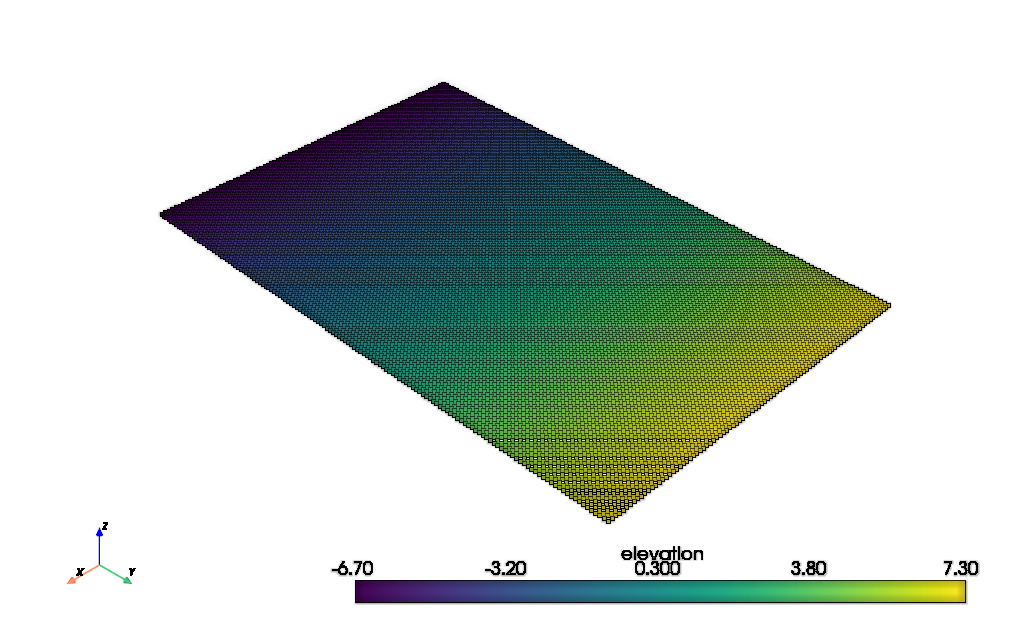
plot a 3d reconstruction using pyvista
import pyvista as pv

stereo = dic_results.stereo
frame = 12


points = np.column_stack((
    np.ravel(stereo.x_mm[frame]),
    np.ravel(stereo.y_mm[frame]),
    np.ravel(stereo.z_mm[frame]),
))

cloud = pv.PolyData(points)
cloud['elevation'] = points[:, 1]
cloud.plot(eye_dome_lighting=True)